Political Liberalism, Confucianism, and the Future of Democracy in East Asia by Zhuoyao Li
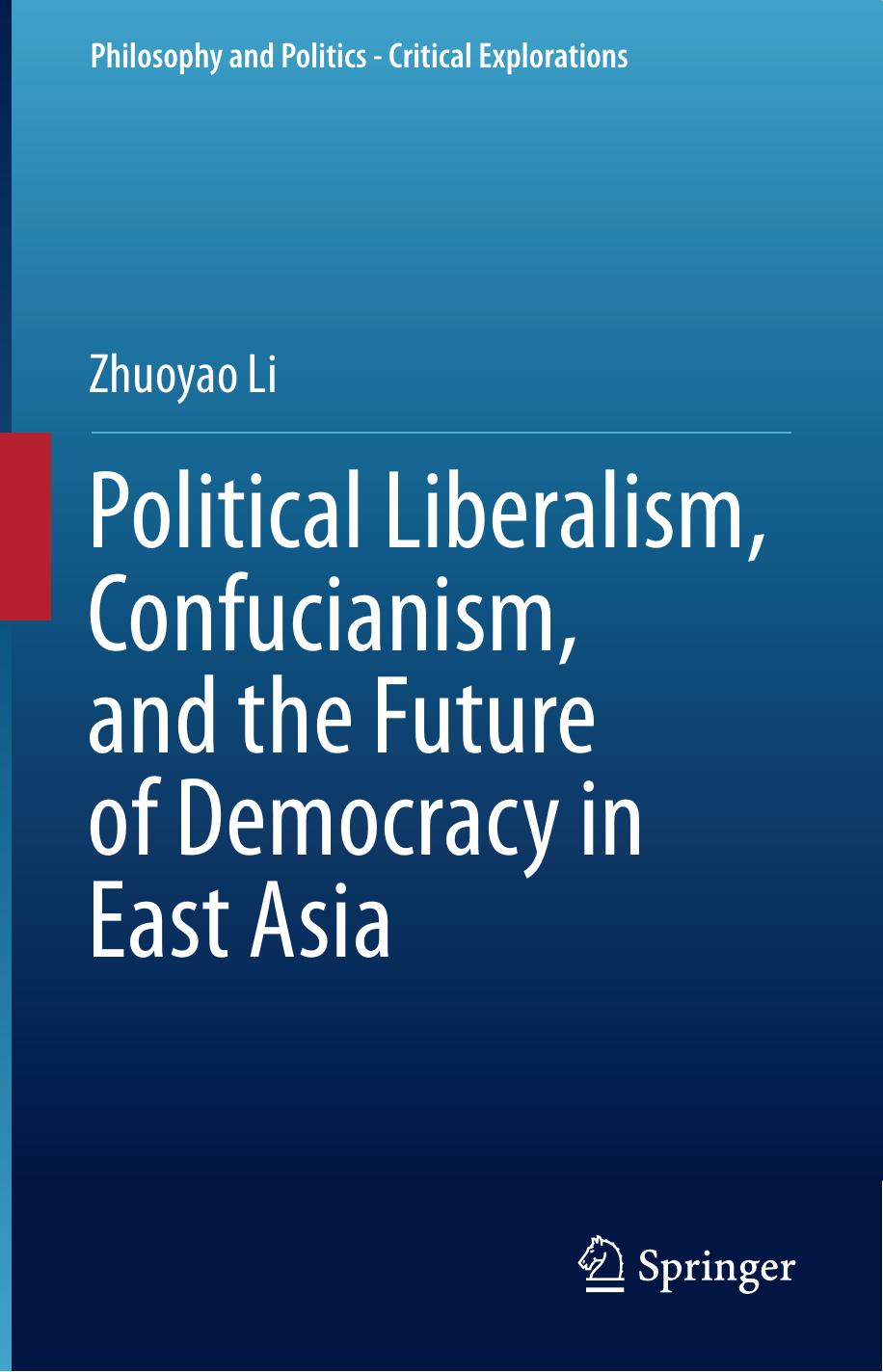
Author:Zhuoyao Li
Language: eng
Format: epub, pdf
ISBN: 9783030431167
Publisher: Springer International Publishing
(2)Is it permissible for a liberal state to promote or discourage some activities, ideals, or ways of life on grounds relating to their inherent or intrinsic value, or on the basis of other metaphysical claims?26
By answering positively or negatively to the first question, we have perfectionism and antiperfectionism. By answering positively or negatively to the second question, we have comprehensive and political approaches to realize and institutionalize perfectionism and antiperfectionism in the political setting: while the former implies that the state will rely on comprehensive doctrines as the basis of its legislation, policy, and other operations, the latter insists that the state ought to be neutral regarding different comprehensive doctrines and avoid making references to them. On the basis of these answers, Quong proposes that we understand liberal political theories in terms of comprehensive perfectionism, comprehensive antiperfectionism, political perfectionism, and political antiperfectionism. When this matrix is applied to the Confucian setting, an obvious imbalance appears between perfectionist and antiperfectionist theories: almost all the contemporary Confucian political theories are perfectionist in nature. To some extent the reason is quite simple. As Sungmoon Kim points out, since Confucianism is “already a self-contained ethical system and a comprehensive doctrine, the answer for [Quong’s first question] is unavoidably ‘yes.’ Otherwise, there would be no compelling reason to struggle with Confucian political theory in the East Asia context.”27 This sentiment motivates Confucian perfectionists to move toward two directions. On the one hand, there is comprehensive Confucian perfectionism, which argues that the state ought to adopt Confucianism as the basis of state constitution, legislation, and policy. For instance, Jiang Qing’s Confucian constitutionalism is an extreme example. Daniel A. Bell’s Confucian meritocracy is a less extreme one. On the other hand, there is moderate Confucian perfectionism, which looks at the broad social trends and environments that undermine or promote human goods and considers if any state action is necessary to create conditions conducive to the pursuit of these goods.28 Joseph Chan’s Confucian political perfectionism and Sungmoon Kim’s public reason Confucianism are recent examples of this moderate approach. Despite the general consensus toward a perfectionist vision of Confucian political theories, Kim’s earlier remark might be a bit hasty and dismissive of alternative approaches. A political antiperfectionist alternative should not be so easily ruled out simply because Confucianism is a comprehensive doctrine. On the contrary, I will argue in Chap. 8 that given the increasingly pluralistic socio-cultural condition of the East Asian region, a political antiperfectionist theory of democracy represents a more reasonable option to accommodate both Confucianism and reasonable pluralism. Before illustrating my position, I will first demonstrate that both comprehensive and moderate Confucian perfectionism suffer from theoretical and practical difficulties. In the remainder of this chapter, I will focus on comprehensive Confucian perfectionism by examining Jiang Qing’s Confucian constitutionalism and Daniel A. Bell’s Confucian meritocracy, and then I will turn to Joseph Chan’s and Sungmoon Kim’s moderate theories in Chap. 7.
Download
Political Liberalism, Confucianism, and the Future of Democracy in East Asia by Zhuoyao Li.pdf
This site does not store any files on its server. We only index and link to content provided by other sites. Please contact the content providers to delete copyright contents if any and email us, we'll remove relevant links or contents immediately.
| Anthropology | Archaeology |
| Philosophy | Politics & Government |
| Social Sciences | Sociology |
| Women's Studies |
The remains of the day by Kazuo Ishiguro(9229)
Tools of Titans by Timothy Ferriss(8605)
Giovanni's Room by James Baldwin(7578)
The Black Swan by Nassim Nicholas Taleb(7289)
Inner Engineering: A Yogi's Guide to Joy by Sadhguru(6907)
The Way of Zen by Alan W. Watts(6737)
The Power of Now: A Guide to Spiritual Enlightenment by Eckhart Tolle(5932)
Asking the Right Questions: A Guide to Critical Thinking by M. Neil Browne & Stuart M. Keeley(5902)
The Six Wives Of Henry VIII (WOMEN IN HISTORY) by Fraser Antonia(5613)
Astrophysics for People in a Hurry by Neil DeGrasse Tyson(5282)
Housekeeping by Marilynne Robinson(4606)
Double Down (Diary of a Wimpy Kid Book 11) by Jeff Kinney(4416)
Skin in the Game by Nassim Nicholas Taleb(4406)
Ikigai by Héctor García & Francesc Miralles(4405)
12 Rules for Life by Jordan B. Peterson(4388)
The Ethical Slut by Janet W. Hardy(4365)
The Art of Happiness by The Dalai Lama(4241)
Skin in the Game: Hidden Asymmetries in Daily Life by Nassim Nicholas Taleb(4130)
Walking by Henry David Thoreau(4085)
